
Vigilant remediation plan ensures treatment plant development
SOUTH BELOIT, ILLINOIS

SERVICES
» Exploratory excavation.
» IEMA reporting.
» Emergency response plans.
» FSI planning.
» Soil samples.
» Monitoring wells.
» In situ hydrogeologic testing.
» Focused Site Investigation Report.
» Remediation Objectives Report/RAP.
» Illinois EPA-issued NFR letter.
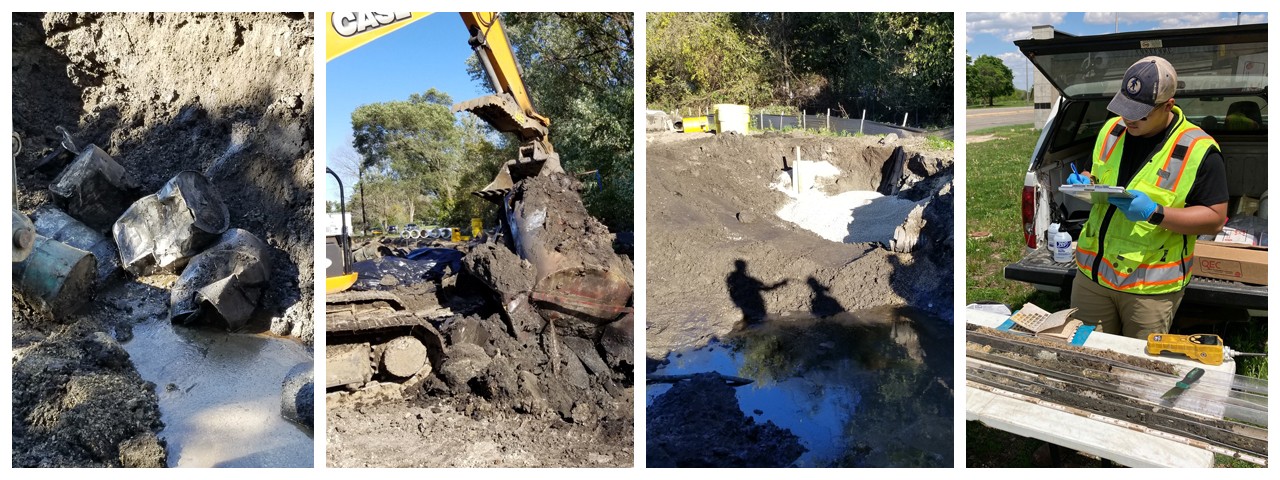
Fehr Graham helped the City of South Beloit, Illinois, improve its Wastewater Treatment Plant by incorporating preliminary, secondary and tertiary disinfection and solids treatment facilities. Fehr Graham also played a pivotal role when underground drums containing petroleum distillates were discovered during site development.
In October 2018, our team identified and removed three buried drums discovered by the contractor. These drums led to a release incident report filed with the Illinois Emergency Management Agency (IEMA) under Incident No. H-2018-0958. Our team swiftly enacted an emergency response plan to mitigate the release, involving drum removal, contaminated soil excavation and exploratory excavations to determine if there were more drums.
Thirty drums containing various petroleum distillate products were discovered and removed. Fehr Graham provided comprehensive oversight throughout the process and played a key role in developing assessment and cleanup strategies.
In February 2019, we conducted a focused Site Investigation (FSI) to characterize post-emergency response site conditions. Our team adhered to regulatory guidelines and industry standards when selecting soil boring locations and monitoring well placements to assess conditions up-gradient, down-gradient and cross-gradient from the site.
We collected soil samples to evaluate residual contamination, and plans were made to install temporary and permanent groundwater monitoring wells to assess potential contaminant migration. We conducted in situ hydrogeologic testing to ascertain hydraulic gradient, groundwater flow direction and hydraulic conductivity. The findings from the FSI were compiled into a Focused Site Investigation Report and a Remediation Objectives Report/Remedial Action Plan (RAP).
The RAP included Tier 2 Risk-Based Corrective Action modeling for benzene in groundwater, which predicted that remaining concentrations would not migrate from the site. A groundwater use restriction was implemented to address groundwater contamination. Engineered barriers, in the form of concrete capping, were employed to manage residual contamination in shallow soils.
To mitigate contaminant exposure, we implemented construction worker notification and building construction controls. This approach led to a final No Further Remediation (NFR) letter issued by the Illinois Environmental Protection Agency in March 2023.
Our remedial actions ensured the safety and success of South Beloit's Wastewater Treatment Plant.
